
Grant County Civil Docket Searches
The first stop is Indiana MyCase, the statewide public Odyssey index. It accepts a case number, citation, cross reference, person, business, or attorney. Any of those works as a search term. Pick Civil, Family, or Probate, then set the scope to Grant County. Filters for file date and open-or-closed status trim a long list. MyCase caps results at 1,000, and repeated searching may trigger a captcha.
An exact case number is the best key. Without one, pair a party or business name with the right category. Add a date range too. Search Marion or Gas City separately only when a city citation matters. Doxpop offers a second route with more filters. Advanced access may cost money, and it never replaces the clerk's official file.
- Choose the identifier, name, business, or attorney search.
- Select Civil, Family, or Probate as appropriate.
- Choose Grant County and add a useful file-date range.
- Match the court, type, caption, filed date, and status.
- Read the CCS, settings, service, motions, orders, and links.
- Contact the Clerk for a missing or certified document.
Other channels matter too. Visit or call the Clerk when the online record is partial. For a mailed or emailed request, confirm the accepted format, fee, payment, postage, and delivery first. The clerk publishes no general online copy-request form. No fixed response time is posted either, so ask before sending anything.
Grant Civil Case Code Map
Grant County civil docket codes work as routing labels. Mental-health matters go to Circuit. Tax sale, estates, and guardianships route to Superior 1. Protection orders, adoption, IV-D support collection, and the listed juvenile categories route to Superior 2. Small claims and eviction land in Superior 3. Domestic, foreclosure, collection, tort, plenary, and several other types may be filed in Circuit, Superior 1, or Superior 2 at the filer's election.
- SC and EV
- Small claims and eviction, normally tied to Superior 3.
- PL, CC, and CT
- Plenary, civil collection, and civil tort.
- MF
- Mortgage foreclosure.
- DC and DN
- Domestic relations with children and without children.
- ES, EU, EM, and GU
- Estate categories and guardianship, assigned to Superior 1.
Codes help you locate a court record. They do not decide the merits or reveal every access rule. A full Indiana number starts with a Grant court identifier such as 27C01 or 27D03, then the filing date, case type, and sequence.
Civil Dockets: What They Show
Think of the Grant County civil court docket as a chronological index. It is not the whole case file. MyCase may show the caption, roles, status, service events, motions, orders, hearings, judgment events, and public document links. A CCS entry confirms only that the system recorded an event. It does not prove service was legally sufficient or reproduce every term of an order.
| Court and code | Identifies the county or city court that maintains the matter. |
|---|---|
| Case type | Distinguishes small claims, eviction, plenary, collection, tort, domestic, probate, and other categories. |
| Number and filed date | Anchors the search and helps verify the intended case. |
| Style and roles | Shows the public caption and system roles when accessible. |
| Service and filings | Records that a summons, appearance, pleading, or service event was entered. |
| Motions and orders | Provides dated signals for requests, rulings, continuances, and judgments. |
| Setting | May list the date, time, place, and kind of hearing or conference. |
| Document availability | Shows whether a remote link exists; absence can require a clerk request. |
"Judgment entered" and "closed" leave out the amount, any property description, and the operative terms. Get the order itself when those details matter.
Grant Small Claims Dockets
Superior Court 3, code 27D03, handles Grant County's small claims and eviction cases. Its official page links to Small Claims forms rather than a separate docket search portal. MyCase stays the public index. Search by exact number or party. Choose the civil category, and verify SC or EV before reading the CCS. A calendar result may label a Small Claims Collection Hearing. That near-term setting is not the full docket.
Call the court's small claims and county traffic line at (765) 668-7145. Superior 3 sits in the county courthouse, and its court line is (765) 668-8123. The county fee page states no small-claims filing fee. So ask the court directly rather than importing a fee from another county or a municipal case.
Local distinction: An SC or EV entry points toward Superior 3, while many other civil codes can appear in more than one Grant court.
What Cases Fill the Civil Docket
Grant County civil court dockets cover claims about money, property, domestic matters, estates, guardianship, and other noncriminal proceedings. Match the category filter to the actual code. "Civil" alone can be too broad, since MyCase offers separate Family and Probate categories and the local rules split assignments among four county courts.
| Matter | Common code | Grant route |
|---|---|---|
| Small claims | SC | Superior 3 |
| Eviction | EV | Superior 3 |
| Estate or guardianship | ES, EU, EM, GU | Superior 1 |
| Protection order or adoption | PO, AD | Superior 2 |
| Mental health | MH | Circuit |
| Domestic, collection, tort, foreclosure, plenary | DC, DN, CC, CT, MF, PL | Shared filing routes |
Case type is just a navigation aid. Family, juvenile, adoption, protection-order, and mental-health records can carry stronger access limits. Search the number and court rather than inferring availability from a broad subject name.
Grant Civil Judgments and Files
A civil docket may show a motion, an order event, a judgment date, or a closed status. It can do all that without publishing the document itself. Need a decree, complaint, exhibit, judgment, or certified instrument? Identify the exact document and contact the Grant County Clerk. The office charges $1.00 per page for photocopies and $1.10 per page for certified instruments. The posted schedule lists no separate civil docket-search or mailing fee.
The Grant Courts FAQ sends a missing divorce decree to the Clerk. That same exact-item approach works for other public documents. Give the case number, court code, event date, document title, and certification level needed. Ask about restrictions, cost, payment, delivery, and turnaround before mailing anything. A transcript goes through the court reporter route. It is not a printout of the CCS.
Hearings on the Civil Docket
A Grant County civil docket can hold many settings. Conferences, review hearings, motion hearings, collection hearings, fact-finding hearings, and trials all appear there. MyCase makes a good first stop. It places each setting in the CCS with the date, time, location, and judge. Indiana Trial Court Calendars is narrower. It shows the past seven days and the next four weeks, and only for participating courts. Grant's calendar list names Circuit, Superior 2, and Superior 3, while Superior 1 is absent. That absence is a publishing limit. It is not proof that no hearing exists. Hearings also move. A reset or continuance shifts the setting but never dismisses the civil case. Confirm the date. The court line, the clerk counter, or the current order all work. No calendar, printed or online, outranks a later notice from the court. Read each setting beside the most recent CCS event. A scheduled hearing may later be moved, cancelled, or resolved.
Grant Probate Docket Boundaries
Probate work in Grant County sits with Superior 1. That court holds the local tax-sale, estate, and guardianship assignments. Use the Probate category in any docket search, along with the case number when you have it. Code clues help too. Estate files carry ES, EU, or EM, guardianship uses GU, and all can point toward 27D01. A public case header still does not put every filing online.
Family cases use their own labels. Cases with children are DC, those without are DN, adoption is AD, and protection orders are PO. Some family papers are party-only or in person. Protection orders also run through Indiana's separate protection-order system. When an index withholds a caption or link, ask about lawful access instead of digging through unrelated court filters.
Who Can See Civil Dockets
Access starts open. Indiana Access to Court Records Rule 4 treats court records as public unless Rule 5 excludes them. Grant County civil court dockets follow that rule.
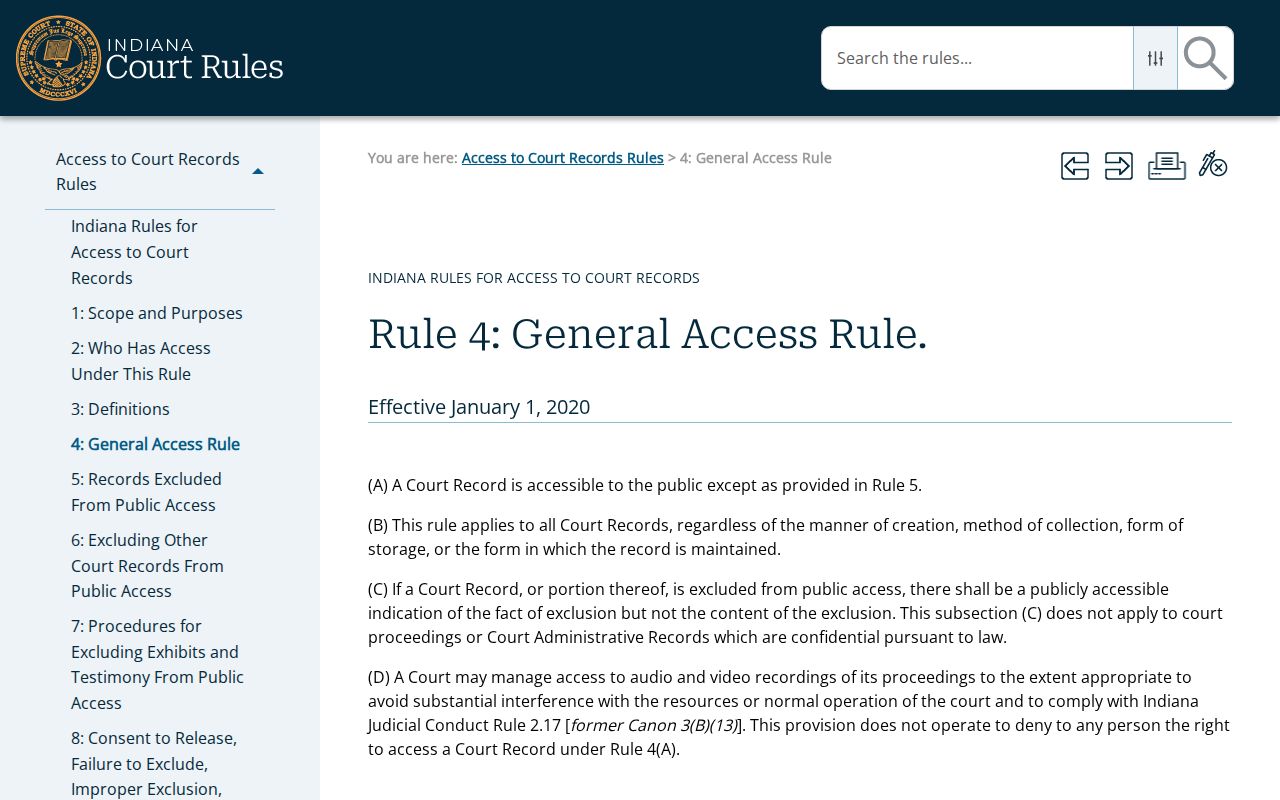
Open does not mean everything shows up online. Rule 5 categories such as sealed cases, mental-health records, juvenile material, protected identifiers, and medical or treatment records may be excluded. A public case can still hold non-remote documents.
Key rules:
Indiana Code § 5-14-3-3 allows inspection and copying during regular business hours, subject to exceptions.
Access Rule 5 identifies confidential, sealed, sensitive, and protected court records.
Access Rule 9 supplies a process for seeking access to excluded court records.
Rule 4 asks courts to flag excluded material without revealing the protected content. A trimmed display may simply mean the system works.
Grant Civil Clerk Requests
The Grant County Clerk of Courts is the county's official custodian of these records. Visit the first-floor counter at 101 E. 4th Street, Marion, Indiana 46952. The phone line is (765) 668-8121. Hours run weekdays, 8:00 a.m. through 4:00 p.m., with a closure from noon to 1:00 p.m. The fax is (765) 668-6541. Call first to confirm the clerk accepts faxed requests.
Grant County Clerk of Courts
101 E. 4th Street, first floor
Marion, IN 46952
(765) 668-8121
Weekdays, 8:00 a.m. to 4:00 p.m.; closed noon to 1:00 p.m.
Search MyCase before you call. Write down the court, case number, type, date, status, event, and document title. Then request the CCS, a filed document, the public case file, a certified instrument, or the transcript route. In person is the clearest fallback. For mail or email, settle format, payment, postage, delivery, and turnaround before sending anything. Staff explain records and forms. They cannot interpret a judgment or give legal advice.